In the golden hush of an African savanna afternoon, when the drama of big-game viewing pauses and the Landcruiser engine ticks cool, many safari guests discover an unexpected joy. It’s not the thunderous roar of a lion, or the distant trumpeting of elephants. Instead, it is the delicate flutter of wings, the whisper of grasshoppers and the intricate, often invisible relationships that bind ecosystems together.
What begins as a quiet moment quickly transforms into a profound exploration of birding and the smaller wonders of the savanna. This is where guests truly fall in love with Africa – not just its icons, but its hidden orchestra.
Picture this, you’re on safari in Tanzania’s Northern Serengeti where the famous Mara River runs through the endless plains and ancient granite kopjes. The midday heat has lulled lions into shade as the great herds of wildebeest and zebra stand motionless on the Mara’s banks. Your guide, with binoculars in hand, points to a lilac-breasted roller perched on a low branch. Its iridescent plumage -shades of turquoise, lilac and blue- catches the light like living jewellery. “Quiet moments are the best for birding”, the guide whispers.

So many of us come to Africa in search of the big five, but leave with hearts stolen by nature’s little wonders, like the small five, and birds.
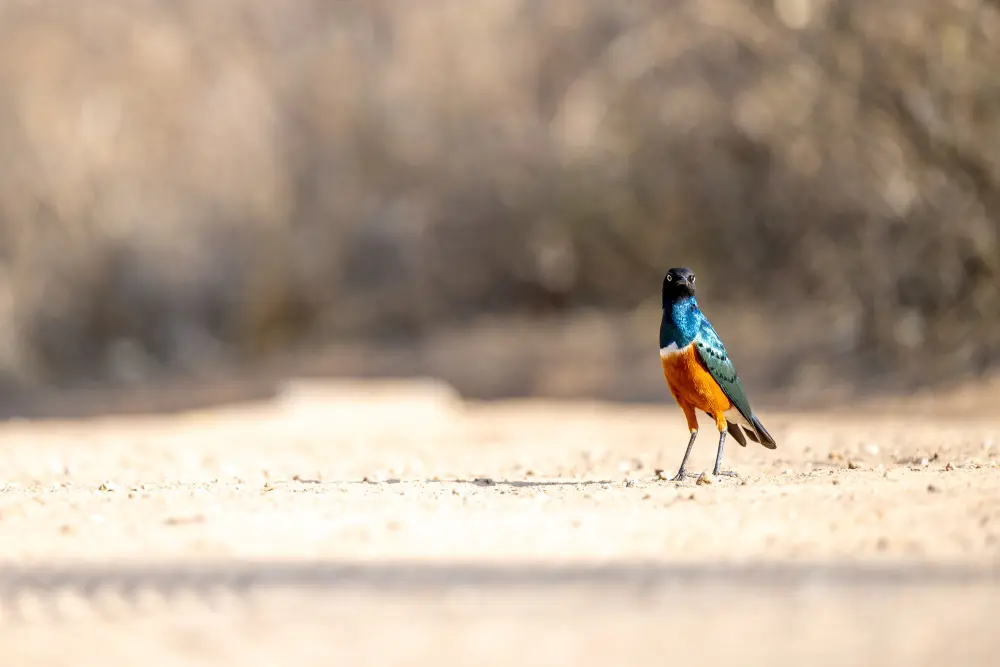
Birding on safari is more than a checklist; it’s an active meditation. Common species like the superb starling, with its metallic blue-green sheen and burnt orange belly, darting between vehicles and feet at designated picnic sites, completely unafraid. The cacophony of weaver males showing off their woven marvels that sway like tiny baskets in the wind, while secretary birds stalk the grasslands on long legs in search of their favourite prey of snakes- a ballet of precision predation.
Yet the real magic lies beyond the birds themselves. Safari guests who linger in the quiet begin noticing the savanna’s smaller, more intricate relationships – the invisible threads that sustain the entire landscape. Take for example, the buffalo and oxpecker. These birds ride atop the massive herbivores, plucking ticks from hides in a classic act of mutualism. The mammal gets pest control; the bird gets a meal.

Or consider the acacia and its resident ants. The whistling-thorn acacia provides hollow thorns as homes to the ants, and sugary nectar as food. In return, the ants swarm any browsing giraffe or elephant, delivering painful bites that protect the tree. While protecting their tree, the ants – and the acacia as a matter of fact- both release pheromones into the air, warning all trees and ants downwind of the impending invasion of predatory browsers. It’s a tiny war waged daily, invisible to those rushing by on game drive.
During quiet moments, guides encourage guests to stop and observe. Suddenly the savanna shrinks from endless horizon to microscopic drama: in the road ahead of them, a dung beetle, rolling a perfect sphere of elephant dung across the dusty road, recycling nutrients that will one day feed the grasses that in turn, feed the herbivores. A lone termite mound, towering like a castle of sand and housing millions, all working in perfect harmony, aerating soil, cycling nutrients and providing homes, albeit it unintentionally in most cases, to snakes, lizards, mongoose and a host of other species, even aardvarks.

These relationships reveal the bush for the living tapestry that it is. Birding becomes the gateway. A hornbill hopping along the ground might lead guests to notice the symbiotic dance between it and the insects it disturbs- beetles and ants fleeing, only to be snapped up. Or a flock of helmeted guineafowl scratching the earth, exposing seeds and grubs, inadvertently aiding in germination while feeding mongooses trailing behind.
A prior guest, a retired botanist, once spent an hour tracing the lifecycle of an elephant dung pile: how it first attracted flies and beetles, then rollers, and even jackals, all cycling nutrients back into the soil within hours. “It’s like watching the planet breathe”, she later wrote in the guestbook.
Passionate guides have embraced this shift. Safaris have become more than simply an opportunity for mega-fauna, but now a first-hand lesson in biodiverse interactions and ecological roles. How each species fits into the tapestry and how their roles transform the savanna.

A new world opens with each “micro safari” we bear witness to, for example the micro-safari of observing Matabele ants returning from war with their plunder in tow. Guests return transformed; families bond over shared discoveries; photographers swap telephoto lenses for macro instead, and even the most seasoned travellers find fresh wonder. “I came for the lions”, one repeat guest shared, “but I stayed for the starlings”.
These quiet moments also foster deeper conservation awareness. Understanding that the loss of a single species ripples through the web – oxpeckers vanishing would burden buffalo and many other mammals with parasites, weakening herds and in turn, their ecosystems. Many conservation groups highlight how things like birding tourism help habitat protection. Guests leave not just with photos, but with a commitment to preserve the intricate balance they’ve witnessed.
In the African savanna, true safari magic isn’t always loud, sometimes it arrives on silent wings, in the pauses between heartbeats, inviting us to look closer, listen deeper, and marvel together at these little bricks of life.
Next time the savanna falls quiet, look closely around you. You might discover that the smallest stories are the ones that stay with you the longest.