By late afternoon in southern Tanzania, the light flattens and the heat begins to ease. Fields of sorghum and maize stand ready for harvest, their heads catching the low evening light. At the edge of the shamba, a crop protection team keeps their torches and a noise ball close at hand. The harvest is close, and everyone is alert.

For many rural farming families across Tanzania, elephants are a real and present threat to their livelihood. A single night raid can undo months of work. In parts of the Ruaha-Rungwa ecosystem, where around 15,000 elephants move across a landscape shared with 120,000 people, the interface between farms and wildlife is expanding. Population growth, in-migration, and land use change are pushing cultivation closer to wildlife corridors.
Human–wildlife conflict is a persistent issue. For families already living on low incomes and dependent on agriculture, the impact is immediate and personal. Crops are lost, livelihoods are destabilised, and frustration builds. Between 2022 and 2024, nine elephants were killed in retaliatory incidents around two game reserves in the Singida region, southwest of Tarangire National Park, while 20 people were injured or killed by elephants across the wider Ruaha–Rungwa landscape in 2023–2024. Conflict here carries losses on both sides.
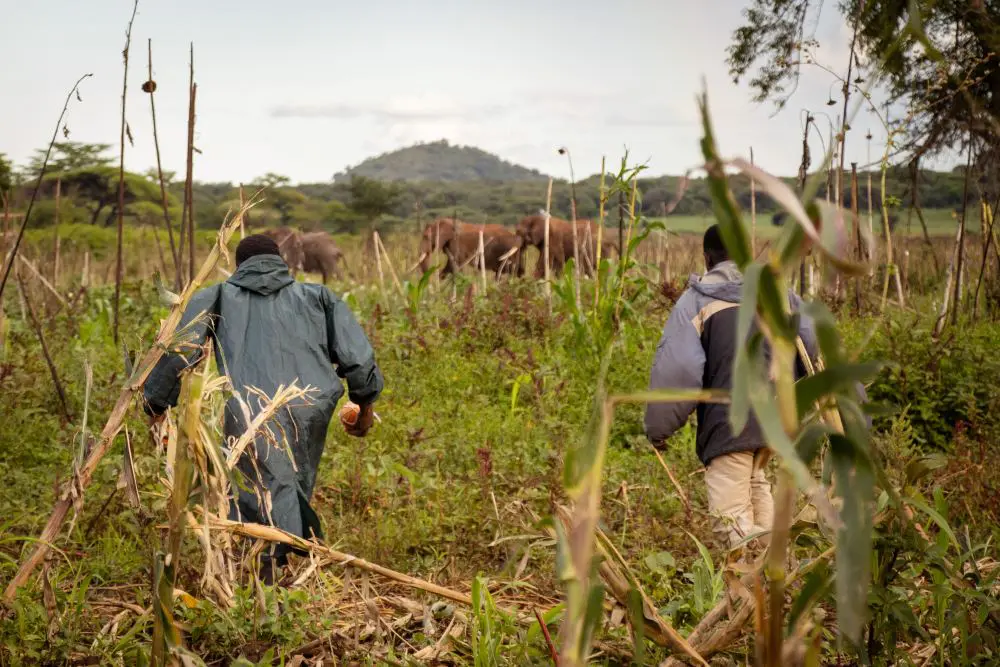
Part of our impact work is to support practical, community-led solutions that reduce the cost of living alongside wildlife. We do this by working with partners who are rooted in these landscapes and trusted locally.
Honeyguide Foundation
Honeyguide is one of our primary impact partners. In the Makao Wildlife Management Area, a 769 square kilometre ecological corridor linking the Maswa Game Reserve, Ngorongoro Conservation Area and Serengeti National Park, they work directly with communities to monitor and respond to elephant crop raiding. Last year, in the first seven months alone, 484 elephant crop raids were recorded in this area. Ninety-seven percent occurred at night. Most targeted sorghum, a drought-tolerant staple that is vital to household food security. Incidents peaked in March, at the end of the rainy season when crops are most vulnerable.

Honeyguide’s approach centres on training and preparedness. They run structured village training sessions that bring together farmers, local leaders and designated crop protection teams. These sessions cover elephant behaviour, safe response protocols, and practical demonstrations of deterrent tools. The emphasis is on teaching people when to intervene, how to intervene, and when to step back.
Each trained team is equipped with a low-cost but carefully assembled toolkit. The first line of defence are high-powered LED torches which disorient elephants at night without causing injury. If they persist noise balls provide a reusable method to drive the animals away from fields. Introduced by Honeyguide in 2024, and also known as the “Jumbosonic”, they are built from local materials and run on rechargeable batteries, pairing a high-pitched siren with flashing LEDs and recording a success rate of over 95% in safely deterring elephants.

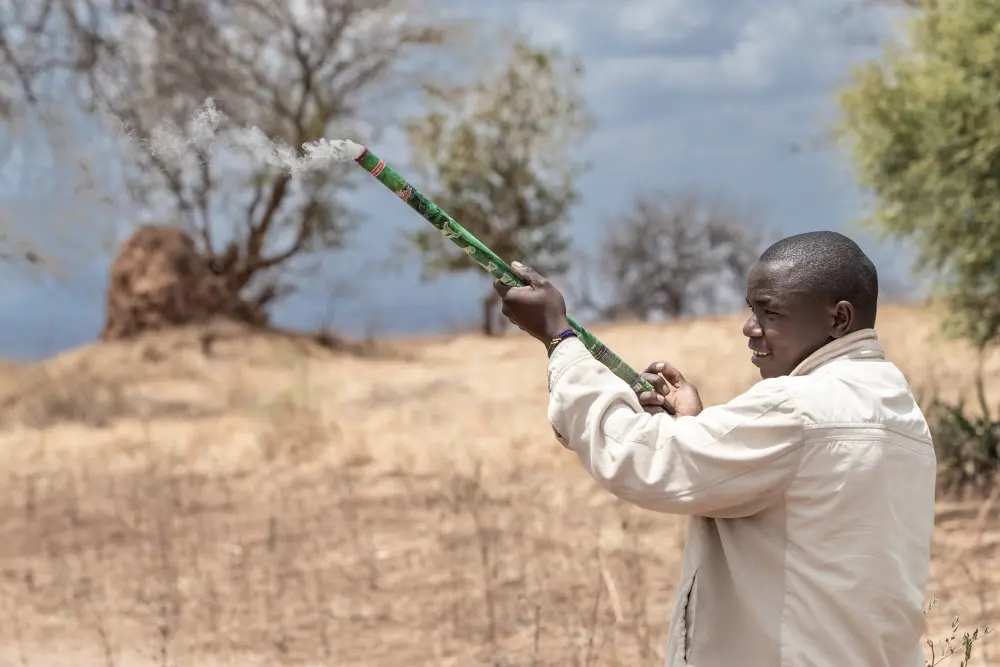
Chili crackers are the next line of defence and combine auditory and physical deterrents via chili powder and firecrackers offering a 78% success rate as a deterrent. Roman candles are the last resort, shot 10-15 meters into the air by a handheld launcher providing a series of loud explosions and accompanying extremely bright flashes creating a loud visual deterrent that can be activated from a safe distance. The tools are basic by design, affordable, portable and locally manageable. What makes them effective is the organisation around it.
The outcomes have been positive. Areas using the toolkit have experienced up to a 90% decrease in crop destruction. Reduced crop damage means increased harvests and improved household food security. Elephants remain a challenge, but they are less often seen only as a threat.
STEP
Further south, in the Ruaha-Rungwa landscape, we work with STEP, the Southern Tanzania Elephant Program. STEP pilots and tests methods that aim to protect crops in ways that are low-cost, locally manageable and adaptable over time.
Currently, we are supporting farmers to implement beehive fences, solar-powered strobe light fences and metal strip fences. Beehive fences rely on elephants’ natural avoidance of bees. Solar strobe lights create disorientation at night, when most raids occur, while metal strips act as a physical and psychological barrier. To date, over eight kilometres of crop protection fencing have been implemented throughout the region. Farmers are closely involved in testing and adapting these measures, building confidence and local expertise.

Across these initiatives, a consistent thread runs through our impact agenda. We are not seeking to eliminate elephants from shared landscapes, nor to romanticise coexistence. We are working to make coexistence viable. That means reducing direct losses. It means building governance capacity within Wildlife Management Areas so they can respond effectively to incidents. It means strengthening relationships between communities and wildlife authorities. And it means recognising that conservation will only endure if it delivers value locally.
Human–wildlife conflict will not disappear. But with the right partnerships, grounded in data, training and local leadership, it can be managed in ways that reduce harm and strengthen the relationship between people and the ecosystems they live within.
When you choose to stay in an Asilia camp, you are actively choosing to contribute towards these, and other, positive impact initiatives across East Africa.