The Alternative Camping Report
Venturing into the great outdoors is one of life’s biggest pleasures. The fresh air, beautiful landscapes and the chance to reconnect with nature do wonders for the soul. But not everywhere is suited for camping.
In fact, according to a report by Statista, the global camping market is projected to make a revenue of US$46.16bn in 2024, with an anticipated annual growth of 5.67% and rising to US$60.81bn in 2029. That’s a lot of happy campers!
Camping doesn’t always have to be taking a tent to a local farm or hiking up a mountain to find a quiet spot. It can also mean taking a campervan on a road trip up the coast or staying at a luxury glamping spot for a little more comfort.
Since camping is different for everyone, the travel experts at Asilia have created the Alternative Camping Index to catch all those hidden gem places you might not have first thought about when planning your dream trip.
Therefore, for this report, we decided to look at the more adventurous aspects of camping without focusing on more practical matters such as safety, the number of dangerous animals and more, so those with a slightly more intrepid spirit know where to wander.
Key Findings:
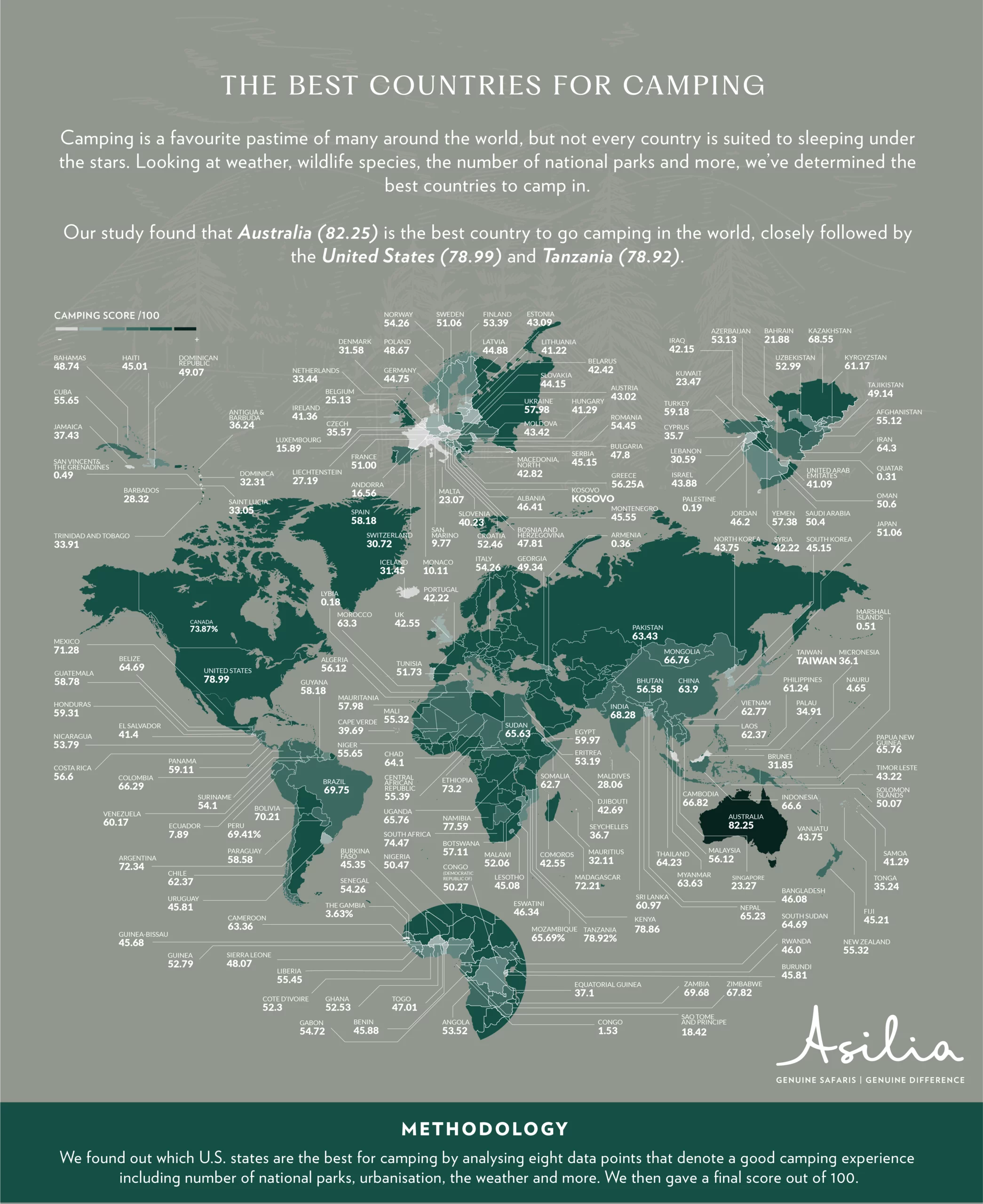
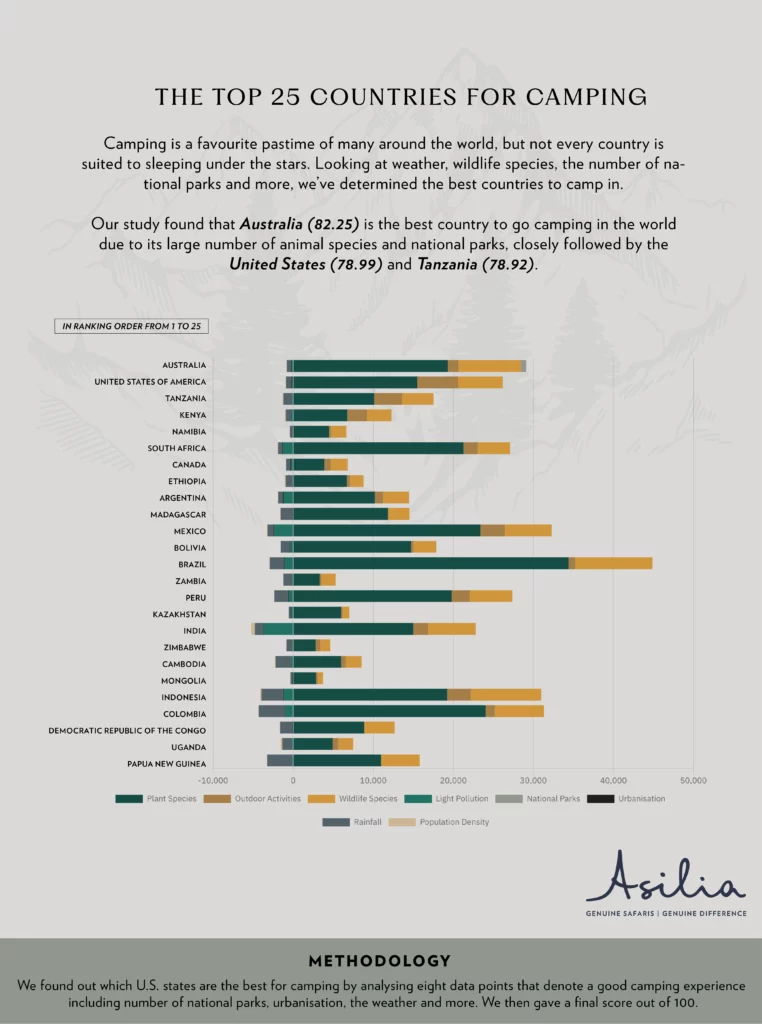
- Australia is the best country to camp in with a score of 82.25 out of 100 boasting the most national parks, lots of wildlife species and the lowest population density.
- The United States comes in second place with a score of 78.99 out of 100 with lots of outdoor activities and minimal light pollution.
- The African countries of Tanzania and Kenya come in close third and fourth place scoring 78.92 and 78.86 thanks to their national parks and lack of urbanisation.
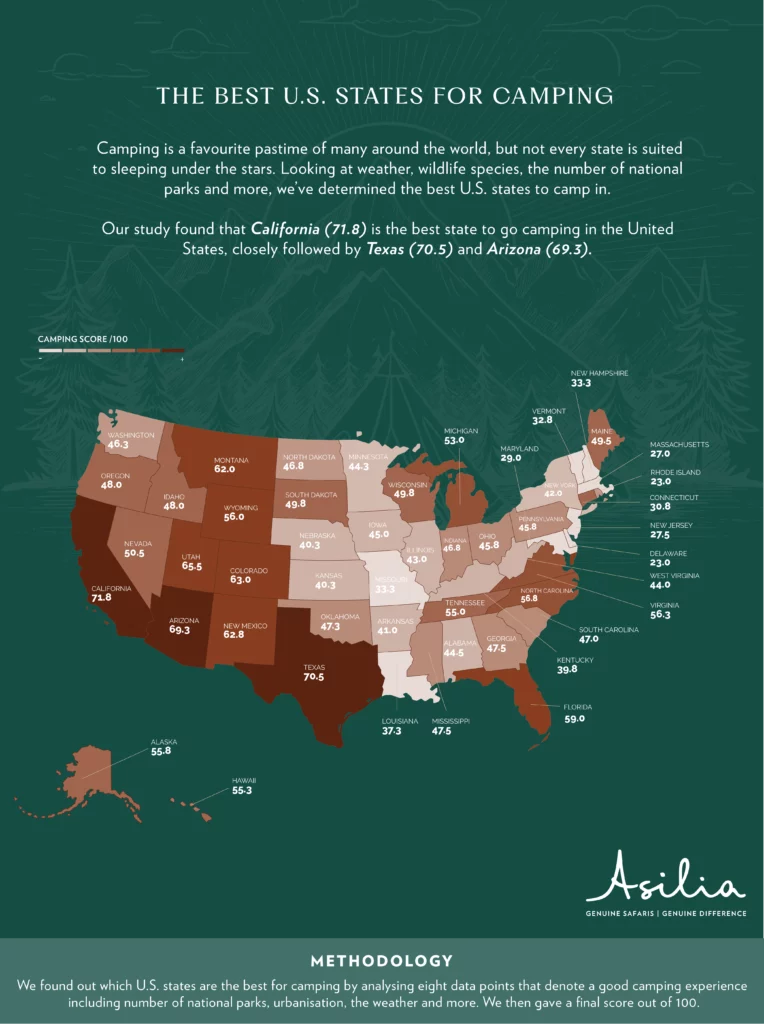
- The U.S. state of California is the best state for camping with a score of 71.8 out of 100 featuring the highest number of national parks and plenty of outdoor activities.
- The southern states of Texas and Arizona come in second and third place respectively with a score of 70.5 and 69.3 out of 100.
How We Conducted the Study
To conduct the study, Asilia first pulled a seed list of all the countries and U.S. states around the world. We then analysed each location based on eight different data metrics which denote a good place for camping: wildlife and plant species diversity, light pollution levels, annual rainfall, number of national parks, urbanisation rates, availability of outdoor activities, and population density.
Using this data, we then calculated a final score and ranked each country and state to reveal the best locations for camping.
Australia Leads as the Top Country for Camping Around the World
Australia and camping go together like Tim Tams and tea. The country has a deep-rooted affinity for camping, offering the perfect blend of stunning landscapes and vast open spaces to welcome everyone eager to embrace the outdoors.

According to Tourism Research Australia, in 2023, Australians took 15.3 million caravan and camping trips with a total spend of AUD 14.3 billion. This surpassed pre-covid levels and was at an all-time high, highlighting just how much Aussies love a good camping trip.
In our study, Australia ranks as the top country to go camping in the entire world, scoring 82.25 out of 100. Oz has more national parks than anywhere else at an incredible 685, covering 28 million hectares from the Northern Territories Kakadu National Park with its diverse hiking trails and thundering waterfalls to the rugged Blue Mountains National Park in New South Wales.
Australia also has a large number of wildlife and plant species which means that those looking to see some of the more unique wildlife that the world has to offer or try their hand at spotting rare plant species need look no further. Australia’s vast size, coupled with its low population density, offers ample room for curious campers to roam freely, and with 1,327 outdoor activities, there’s plenty to do.
The United States Ranks as the Second-Best Country for Camping
On the other side of the world, the United States has ranked in second place as one of the best countries to go camping with a score of 78.99 out of 100.

This comes as no surprise, given that camping is one of America’s favorite hobbies. The 2024 Camping and Outdoor Hospitality Report from Kampgrounds of America shows the number of households who identify as campers in the U.S. has increased by 23% over the past decade to 16.5 million.
The United States is an excellent destination for camping due to its extensive system of public lands, including national parks, national forests, Bureau of Land Management (BLM) lands, and state parks. These areas are often set aside for recreational use, offering countless campsites, hiking trails, and scenic spots. Many of these public lands provide well-maintained facilities, including established campgrounds, picnic areas, and trailheads, making it easy for campers to explore.
Tanzania Earns Third Place Among Top Camping Spots
Tanzania might not be everyone’s first choice when looking for a country to go camping, but when you take into consideration its beautiful natural surroundings, variety of unique wildlife species and luxury safari camps on offer, it quickly stands out as a top destination.

Tanzania came in third place in our study with an impressive score of 78.92 out of 100. The country has a very low urbanisation score, with 37.4% of its total population living in urban areas, meaning there’s a higher chance of authentic rural experiences. There’s also a very low amount of light pollution once you venture further from the cities, making it one of the top places in the world to experience stargazing.
The African nation offers a wide array of outdoor activities, including once-in-a-lifetime safaris to one of its many national parks. Experience The Great Migration in Serengeti National Park or explore the stunning landscapes and unique boating safaris found at Ruaha National Park.
For a luxury camping experience, discover some of Asilia’s premium accommodations, such as Olakira Migration Camp, which follows the Great Migration across the Serengeti, and Rubondo Island Camp, located on a secluded forested island in Lake Victoria.
Kenya Ranks Fourth as a Luxury Camping Hotspot
Kenya, known as the Pride of Africa, keeps up its reputation and comes in as the fourth top country to camp in the world. Home to some of the friendliest people in the world and boasting breathtaking landscapes, it’s easy to see why the country ranks among the top luxury camping destinations.
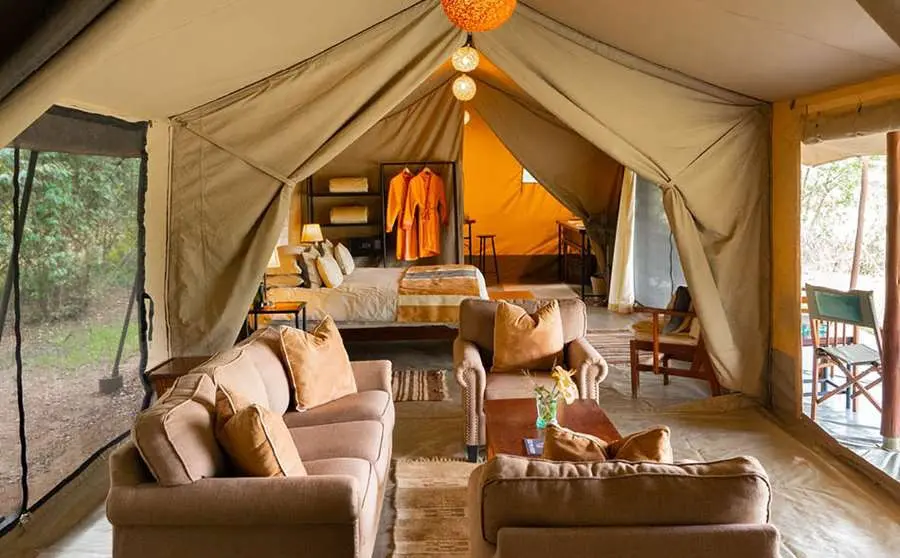
In our study, Kenya receives a score of 78.86 out of 100, placing it among the top four camping destinations in the world. The country ranks high for its number of unique outdoor activities to keep any camper on their toes, including hot air balloon rides, mountain hikes, river rafting, and even eating breakfast with giraffes.
Kenya has many national parks to explore, making it one of the best places to visit for wildlife and unbridled nature. Campers can visit the Masai Mara, where they’ll be able to spot some of the most unique wildlife in the world, from elusive big cat to majestic elephant. For a truly exclusive safari experience, Mara Naboisho Conservancy plays host to cheetah, elephant, giraffe and its unbeatable concentration of lion.
Explore the top countries for camping in our world map below:

You can view the map in full-size here.
The Top U.S. States to Go Camping
Although we know that the United States as a whole ranks second in the world for camping, the country is so large that each state has its own advantages and disadvantages. From breathtaking national parks and diverse landscapes to varying weather conditions and accessibility, camping can differ significantly from one state to another.
While Florida might be a great place to spot unique wildlife and get out into nature, the state might not actually be great for camping due to its urbanisation and heavy rainfall. In contrast, Rhode Island might have plenty of places to camp with miles of coastline, but it has no National Parks of Dark Sky Reserves to enjoy.
To identify the best camping spots in the U.S., Asilia employed the same data metrics used to analyse the top countries, substituting light pollution levels with the number of dark sky reserves.
Explore the map below to discover which U.S. states are the best for camping.
California Leads as the Best State in the U.S. For Camping
When comparing all the states in the U.S., The Golden State of California comes in as the best destination for camping, beating out all other areas for its expansive natural parks and great weather.

In our study, California scores 71.8 out of 100. The state has the highest number of national parks than anywhere else in the U.S. with nine in total, including the world famous Yosemite and Joshua Tree national parks, completely eclipsing any other state. There are also plenty of outdoor activities to enjoy, from rugged hikes to lakeside dips. Not only this but California is also incredibly diverse offering some of the most species of wildlife and plants in the U.S.
However, the state scored poorly as the most urbanised area of the United States meaning that those living outside of city areas are few and far between. It also scored poorly for population density with 92.06 per square kilometer meaning those looking for a more secluded camping experience might struggle to find the quiet they crave.
Texas Comes in as the Second Top U.S. State for Camping
While Texas is known for its cowboy culture and large cities, it’s also one of the best states in the U.S. to go camping. The state has endless natural attractions, including hiking trails, rock formations, national parks and caves, which make it the perfect place to go and experience the great outdoors.

In our study, Texas scores 70.5 out of 100, making it one of the best states to grab your tent and head out into the wilderness. The state has the largest number of plant species than any other state and is the third most biodiverse in terms of animals, so if you’re into seeing wildlife, Texas is the place to go. The state also has the third highest number of Dark Sky Reserves in the U.S. with ten places to stargaze, including Big Bend National Park in West Texas.
However, the state ranks low on some metrics, such as its urbanisation, with 83.7% of its population living in urban areas and not in the great outdoors. Similarly, it has a population density of 43.17 people per square kilometer, making it a busy state where you might not find much quiet.
Arizona Ranks as the Third Top State to Camp In
Nestled between both California and Texas, Arizona ranks as the third top state to go camping in the whole of the U.S. This sunny state has some of the best natural habitats of any location and enough campgrounds to keep up with demand.

In our study, Arizona scored an incredible 69.3 out of 100, solidifying it as one of the best places in the U.S. to camp in. The state has the most dark sky reserves to take advantage of than any other state at thirteen, including Grand Canyon National Park and even the city of Flagstaff. It also has very low average yearly rainfall at just 13.6mm, so you don’t need to worry about getting caught out in the cold.
Although Arizona has a lot going for it, in terms of wildlife and plant species, it scores in the middle of the road for all states, meaning if you’re looking to go exploring for interesting animals, it might not be the place to visit. Just over 89% of its population also live in urban areas, which means you’re less likely to find a true escape into nature when camping.
How Camping Enhances Your Well-Being
Now we know the best places to camp around the world, we wanted to know the benefits of camping and why you should consider taking to the wild for your next holiday.
From the mental and physical health advantages to the opportunity for adventure and connection with nature, camping offers a unique experience that can rejuvenate your spirit and create lasting memories.
John Baumann, one of our resident camping safari experts explains how camping is good for you.
“Camping is one of the most underrated activities when it comes to overall well-being. It offers a perfect blend of physical exercise, mental relaxation, and social bonding. Being in nature allows you to step away from the pressures of daily life, which can drastically reduce stress and anxiety levels.
“Exposure to natural light helps reset your internal clock, promoting better sleep, while the physical activities associated with camping—like hiking or setting up camp—improve cardiovascular health and increase strength.
“There’s also a therapeutic aspect to simply being outdoors. In nature, we experience a calming sensory environment, which lowers cortisol levels and boosts serotonin, improving mood and mental clarity.
“Camping provides a space for mindfulness, creativity, and deepening relationships. It’s an all-in-one approach to health that many people don’t realise they need until they experience it firsthand.”
Catalin Zorzini, founder of nature non-profit, Earth.fm, said:
“Research by the University of East Anglia found that spending time in nature reduces stress, high blood pressure, and the risk of cardiovascular disease, among other health and wellbeing benefits. Camping brings us even closer to this experience, so it’s no wonder that a night spent under the stars drifting off to the sound of chirping crickets is like medicine for the soul.
‘Want to know what sort of nature sounds you might hear on an Asilia Africa safari? Earth.fm’s community of professional field recordists have captured pure and immersive natural soundscapes from all over world – listen to George Vlad’s recording of the Masai Mara in Kenya, or elephants browsing at night in Tanzania by Kin Corning.”
Feeling Inspired?
Has our study inspired you to go on a camping trip of your own? Explore our luxury safari camps and lodges in the top countries for camping or speak to one of our East Africa Specialists who can help you plan your dream camping experience..
Methodology
To find out the best countries for camping, we first pulled a seed list of every country and U.S. state in the world. Then, using this list we analysed eight different data metrics that denote if a location is a good place for camping including:
- Number of wildlife species – https://worldrainforests.com/03highest_biodiversity.htm
- Number of plant and fungi species – https://worldrainforests.com/03plants.htm
- Light pollution – https://www.lightpollutionmap.info/LP_Stats/
- Yearly rainfall – https://data.worldbank.org/indicator/AG.LND.PRCP.MM
- Number of national parks – https://en.wikipedia.org/wiki/Lists_of_national_parks
- Urbanisation – https://en.wikipedia.org/wiki/Urbanization_by_sovereign_state
- Number of outdoor activities – https://www.tripadvisor.com/Attractions-g293747-Activities-c61-Tanzania.html
- Population density – https://en.wikipedia.org/wiki/List_of_countries_and_dependencies_by_population_density
We then assigned a score to each data metric for each country and calculated a final overall score for the best countries to camp in. These were ranked from the highest score to lowest.
Please note Russia scored 80.6 on our metric scale but was removed from our top featured rankings as it currently isn’t recommended to travel there.
We also analysed the top U.S. states to go camping using the same metrics but slightly different sources. We assigned a metric score and final score in the same way as our country ranking and ranked from highest to lowest.
The data was pulled in October 2024.