In the late 1980’s, ivory poaching was at its peak, resulting in a dangerous decline of both rhino and elephant numbers across Africa. In Kenya, the Aberdare ecosystem was under severe threat as the population of Black Rhino were being decimated by poachers, and local communities pillaged the resources of the forest.

Water and wildlife
160km north of Nairobi, the Aberdare Range plays a vital role in the support of the country’s economic development and environmental stability. Four out of seven of Kenya’s largest rivers rise in the Aberdares, providing power and water to major towns, including the 3 million residents of the capital city, Nairobi. 4 million farmers depend on the nutrient rich soils and rainfall amongst it’s foothills, where 70% of the country’s coffee is grown. The dense forest is home to a variety of wildlife including elephant, leopard, black rhino and the critically endangered mountain bongo. Encroachment of agricultural activities into close proximity with the park, were leading to regular instances of human-wildlife conflict resulting in crop damages and even human fatalities. Bush meat poaching, illegal snares, logging and charcoal burning were all taking an effect on the ecosystem.

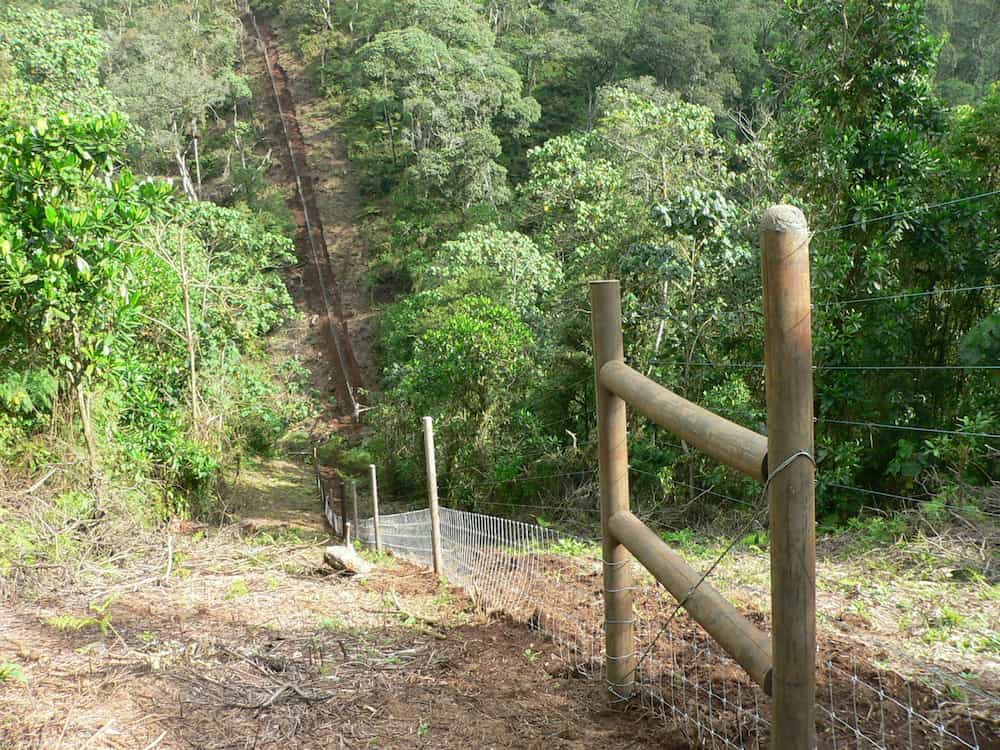
In 1988, the Rhino Ark Kenya Charitable Trust was established, with an initial objective of building a 38-kilometre game-proof fence around a stretch of the park border that jutted out into surrounding farmlands. As most incidences of poaching and human-wildlife conflict seemed to be occurring in this vicinity, it was hoped that the fence would keep the wildlife in, and the people out. Over the next 21 years, the 38km fence grew into the world’s longest conservation fence, covering nearly 400 kilometres in length and protecting over 2,000km2 of prime forest and water catchment areas.

Creating harmony
The guiding philosophy behind Rhino Ark is “Humans in harmony with habitat and wildlife”. In order to achieve this, considerable focus needs to be applied to local communities living in close proximity to the forest edge, to provide education as well as create sustainable income-generating programs. A livelihood of relying on the resources of the forest for energy, sustenance and income requires education for understanding, and implementation of alternative methods of gathering resources. The creation of employment is vital in the process of garnering community support. “Fence Scouts” were recruited from surrounding communities, trained to handle daily running repairs and patrol the perimeter of the fence. Tree nurseries were created outside the fence, growing both indigenous and exotic species. The indigenous species form a part of a tree-planting program inside the fence, while exotic woods are sold to the local carpentry trade, offering a certified and sustainable alternative to illegal logging. As the fence prevents crop-raiding, farmers are now collecting 100% of their crop yield, boosting revenue and increasing the value of their land.

The successful implementation of the Aberdares project quickly led to the identification of additional forest ecosystems requiring a similar level of support, such as Mount Kenya, Mount Eburu, Southwestern Mau and the Kakamega Forest. Each of these regions play important roles in the supply of water and electricity to Kenya, as well as holding rich biodiversity in both fauna and flora. However, each region was facing similar challenges in terms of logging, poaching, human encroachment and human-wildlife conflict. Similar models to the Aberdares project were rolled out in these regions, offering support, education and employment to surrounding communities, and erecting fences around the forest reserves for the protection of wildlife and forest resources, whilst also protecting surrounding farmlands from crop-raiding. To date, over 700 kilometres of electric fencing has been built around some of Kenya’s precious forest systems, serviced and maintained by “Fence Scouts” employed by Rhino Ark.
Rhino Charge
Funding such ambitious projects was always going to be a challenge, but an innovative idea went on to become the biggest off-road 4×4 event in the country, providing significant funding to Rhino Ark: The Rhino Charge. Conceived to initially raise funds for the Aberdares project and held for the first time in 1989, 31 vehicles competed to navigate to a series of checkpoints over the shortest amount of distance possible. The event only raised a little over US$1,700. Little did these initial competitors and organisers know, this event would go on to gain international acclaim, attracting entries from all over the world.

Today the number of vehicles permitted to compete each year is capped at 65. Teams have 10 hours to visit 13 check points, scattered over approximately 100 square kilometres of treacherous terrain. The team that reaches all 13 check points over the least amount of distance, is declared the winner. Additionally, each team is required to raise a minimum amount of US$5,000, which totalled over US$1.2 million raised in 2023. While this event now serves as a major fund-raising initiative for Rhino Ark, it also carries significant community development support for the area hosting the rally. The location of the race changes from year to year for the protection of the environment, and is kept a closely guarded secret until the point of release. The event requires the creation of infrastructure and on-the-ground assistance, creating temporary employment opportunities and supplementary income for the local communities. Entrants pay a vehicle fee, which goes to the local landowners and host communities, used for community projects like boreholes and classrooms. The 2023 event was won by “Team 48”, their 6th Rhino Charge win in 14 attempts. Although operating in a personal capacity, we’re always proud of our Asilia Operations Director, Gerard Beaton, who has been a racing member of Team 48 since 2005.
It’s a charity that has amazing governance, knowing every Shilling raised goes towards the cause.
Gerard Beaton