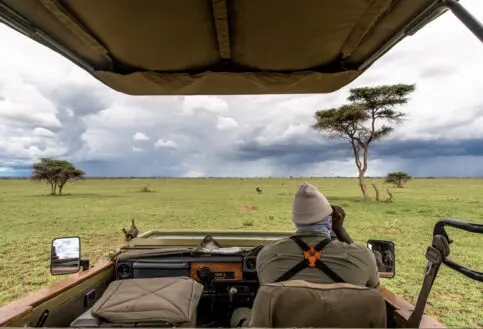
I’d been to Kenya, and even to the Mara Naboisho Conservancy many times, but never like this. This time I was seeing it through my son’s eyes. Rupert, age nine, sat beside me as our Land Cruiser bounced along the red-dirt track that passed through low scrub and open plains, thorn branches tapping the vehicle as we passed.
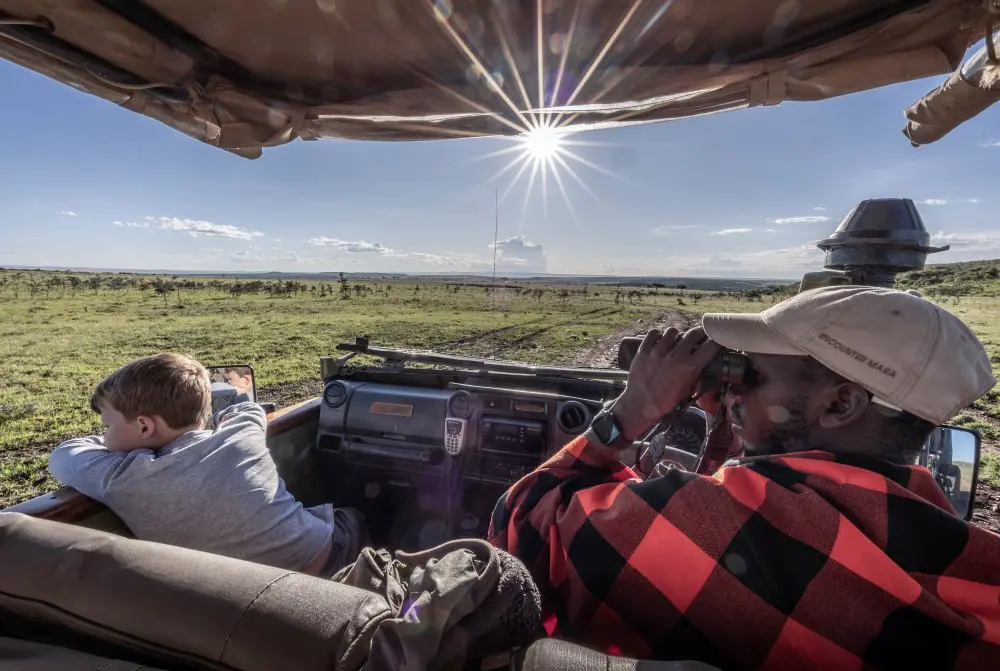
There was that familiar scent of the bush, the mix of sage, dust and sun-warmed wood that settles into your skin. Just minutes into the drive we spotted giraffe, followed by zebra, then a small herd of elephants. Each sighting sparked something new, an urgent whisper telling me to look. His excitement and sense of wonder were barely contained, a kind of full-body joy that is hard to describe. Watching him, I was pulled back to my own first sightings, when every movement in the grass made my heart jump. That feeling never quite leaves you, but it does fade with familiarity. This time, it came back sharper, stronger. Seeing it in him made safari new again for me too.
Nine is a good age for safari. Old enough to sit still for long stretches, to take in what’s being said by a guide, and to understand the difference between watching and disturbing. But still young enough for everything to feel like magic, and to feel that thrill of anticipation of what might appear next on a game drive. An added dimension to our safari that I hadn’t planned came about when I handed him my camera.

On our first drive, a cheetah lay stretched out in the grass, its back arched like a comma beneath the canopy of an umbrella thorn. My son had never used a DSLR before, but I explained the basics of composition; how to frame an image, how to leave space for an animal to move into, and how not to cut off feet, tails or ears.
Rupert has always been good with technology, of an age where tablets and phones are second nature. Still, I was surprised how quickly he grasped the camera controls. The lens was longer than his forearm. He held it carefully as I gave him a few basic instructions to begin with, showing him how to hold the camera steady, how to frame the subject without cropping out feet or the tips of ears, and how for the best shot he needed to wait for the animal to look up.

He took to it with quiet concentration. In the beginning, he made quick clicks, hoping to catch something. But as time passed, he was watching the animals more closely. He’d seen how a lion might look up just before rising, or how a cheetah flattens its shoulder blades before it moves. He began to anticipate moments rather than react to them.
There’s a growing body of research showing how photography benefits children, particularly when taken outside. Studies suggest it builds observational skills and encourages patience. A camera offers both creative control and technical challenge. The process of learning settings and framing subjects also enhances visual literacy. Children start to understand not just what they’re seeing, but how to interpret it.

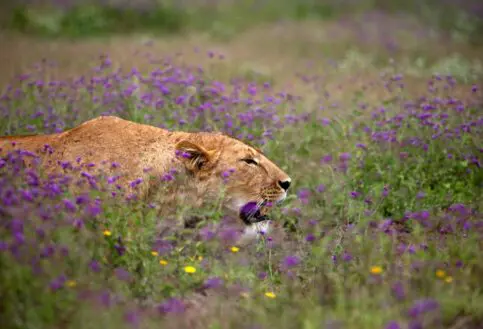
Later, when two male lions emerged from the bush and walked slowly to a river to drink, Rupert was silent and fully focused. As the lions drank, he watched for the moment one might lift its head. When it did, and the eyes met his through the lens, he caught the shot.
That focus became a theme. Photography gave him a challenge, and he leaned into with full attention and awareness. Photography helps you notice things others sometimes miss, such as how light shifts and how animals behave just before they move. Rupert became absorbed in all of it, learning how to see. There’s something about photography that gives children ownership of their experience. Rather than being passive observers, they become participants.

At camp in the evenings, he would scroll through his images, deleting the blurry ones, quietly proud of the frames that had worked. By now, his confidence had grown. He would study the images he liked and ask questions about the ones he didn’t. During our safari there were plenty of photographic opportunities. He photographed lions on a fresh kill, a large herd of elephants stopping to drink at the river, giraffes threading their way slowly between Acacia trees, noisy baboons squabbling near the river. He began noticing things in a way I hadn’t anticipated.
In practical terms, safaris offer an ideal classroom. The open structure of the day, the long hours in a vehicle, the sudden intensity of a sighting suit the rhythm of photography. You don’t need expensive kit, a point-and-shoot camera would have been enough. The tools aren’t important. What matters is giving children a reason to look carefully, to wait, to make something from what they see. I would recommend any parent to consider the option of taking a private vehicle if they’re travelling with children. It allows space to linger, to talk through sightings, to pause without pressure.

A photographer myself, watching him behind the camera, I saw the landscape through his lens and watched him grow and learn. He wasn’t just taking picture, he was learning to wait, to notice, and to think about what story he wanted to tell. In doing so, he paid closer attention to the place we were in. Safari will always be an adventure for a child, but with a camera in hand, it became something more, something that encouraged him to be still, and to really see.
Chat to us today about planning a safari suited to the ages of your children.