Across East Africa, women are reshaping the safari industry in powerful ways; from guiding guests through the untamed wilderness to leading conservation conversations and challenging long-established gender roles in the bush.
For many safari travellers, being guided by a woman offers a fresh perspective. Female-led safaris tend to feel different – there’s a difference in the storytelling, in the pace, the interpretation of the wild.
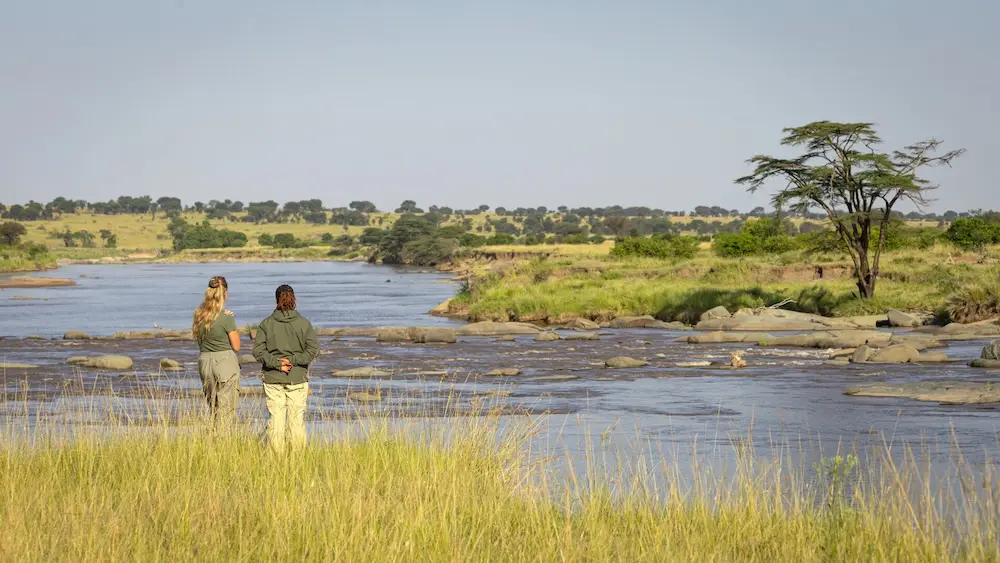
At Asilia Africa, female guides are redefining safari guiding across Kenya and Tanzania. But it doesn’t stop at guides – across our portfolio, female guides, camp managers, and conservation leaders are changing the safari industry, and they’re doing it with heart.
Why Female Safari Guides Matter
Safari guiding has traditionally been a male-dominated profession. As more women enter the field, we’re seeing a shift that matters far beyond optics.
Female guides bring the same rigorous expertise as their male counterparts: deep knowledge of animal behaviour, tracking, ecology, bird identification and vehicle mechanics. But they also bring a different style of communication – patient, narrative-driven, and emotionally intelligent. Guests who might feel intimidated asking questions often find female-led drives more conversational and easier to engage with.
Representation is an important part of it, too. The more local women take up professional roles in the safari industry – as guides, camp managers, conservation leaders – the more role models there are to inspire the next generation. For young girls in rural Kenya and Tanzania, seeing a woman steer a Land Cruiser across the open savannah and showing travellers the intricacies of the wild is genuinely transformative.
Women working in the industry also tend to have stronger ties with local communities. They understand the relationship between local livelihoods and wildlife protection in ways that translate into authentic, grounded conservation storytelling.
What It’s Like to Go on Safari with a Female Guide
Female guides often bring a softer quality to game drives and a warmer atmosphere. On game drives, female guides are typically more attuned to detail, patient with behaviour, and skilled at creating a sense of anticipation for what might happen next. They tend to let the moment breathe – intuitively reading the moment and narrating it beautifully.
When out on foot or on a game drive with a female guide, guests often comment on the storytelling, which so skillfully connects an animal’s behaviour to the wider ecosystem. It’s something more than knowledge gained through years of training; it’s an instinct for the emotional connection.
Back in camp, female guides and managers bring a genuine warmth and attentiveness to the guest experience. They care. And it shows.

Women Breaking Barriers in Kenya and Tanzania
The path to becoming a safari guide in East Africa is not straightforward for anyone. But for women, the barriers are compounded.
Cultural expectations in many communities still favour women in domestic roles, with families reluctant to support the ambition of girls wanting to pursue guiding careers. With no footprints to follow, girls are often unaware that guiding is even an option for them.
Access to formal guide training has historically been limited for women, particularly in rural areas, while many guide training programmes focus on skills such as driving and vehicle mechanics that are traditionally considered male roles.
Thankfully, the tide is turning. Safari operators, conservancies and training schools are actively recruiting and supporting women. Mentorship programmes, bursaries, and flexible training structures are enabling women to enter and progress in the profession.
Increasingly, we’re seeing women holding leadership roles – camp managers and senior guides – after having worked their way up the ranks.
Evalyn Mayetu: One Guide’s Story
Evalyn Mayetu grew up in a nomadic community in Kenya. Girls here didn’t go to school, and they certainly did not become safari guides. At nine years old, she left her family to pursue an education – the beginning of her journey to become one of Kenya’s first female Silver-certified guides through the Kenya Professional Safari Guides Association. She is currently working towards Gold – the highest qualification available – while also completing a degree in Conservation Resources.
Evalyn joined Asilia in 2015 and works as a guide at Naboisho Camp. Her dream is to open a school for girls in her village.
“Guiding came naturally to me. I wanted to do something only men do.” – Evalyn Mayetu.
Read her full story: Voice of Our Guides: Evalyn Mayetu.

Inside Asilia Africa’s Female-Led Safari Experiences
Asilia Africa has long been committed to gender inclusion as a genuine reflection of the kind of company it wants to be and the kind of safari it believes in.
At Dunia Camp in the Serengeti, women have been leading the charge. As the first all-women-run camp in East Africa, Dunia is a model of what a female-led safari can be, offering an intimate and elevated guest experience in a spectacular wilderness setting.
Across the portfolio, female guides, assistant managers, and camp managers are active participants in shaping the guest experience. Asilia’s approach is to actively support women through every stage of their career through mentorship structures, training pathways, and a culture that values progression.
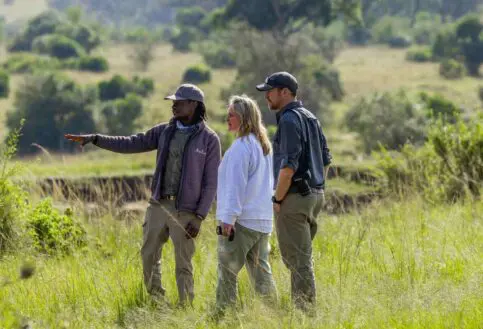
Menina Nightingale, a Kenyan-born assistant manager and walking guide at the Mara Naboisho Conservancy, is an example of how female leadership is embedded in the heart of Asilia’s operations. Her role spans guest experience, conservation education and team mentorship.
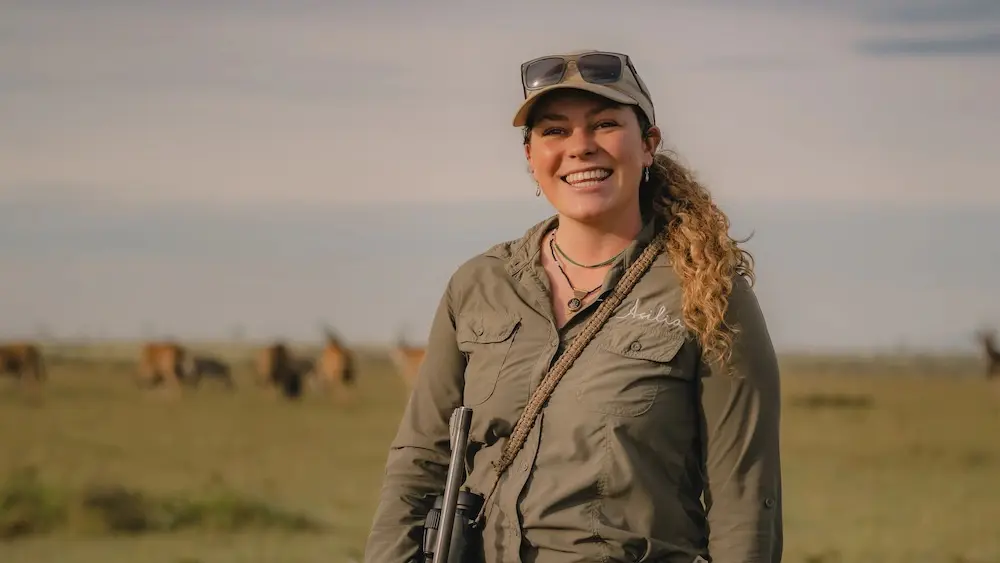
The Best Safari Destinations to Experience Female-Led Guiding
Serengeti, Tanzania
The Serengeti is one of the world’s great safari destinations – vast, ancient and dramatic. At Dunia Camp, female guides lead guests through a landscape shaped by the rhythms of the Great Migration and the year-round drama of predator-prey interaction. This is an immersive safari, with small group sizes and highly personalised guiding at its core.
Mara Naboisho Conservancy, Kenya
The Mara Naboisho Conservancy is one of Kenya’s finest community-owned conservancies, offering an uncrowded experience and a deep commitment to conservation. With significantly fewer vehicles than the main reserve, sightings feel almost private and blissfully unhurried. Female guides here bring an intimate knowledge of the landscape and its wildlife, alongside a genuine connection to the communities that protect it. Walking safaris offered from Naboisho Camp add an entirely new dimension to your safari.
Ruaha and Remote Southern Tanzania
For guests seeking a truly wild and untamed experience, Ruaha offers something increasingly rare: genuine remoteness. Guides here have to be of the highest level, as this untouched landscape is complex, demanding, and ecologically rich. Female guides operating in Ruaha bring expertise honed through years in the field and an approach to the wilderness that matches the ambition of the destination.
Why Women in Safari Matter for Conservation
Tourism and conservation are deeply intertwined across East Africa. The model that sustains Asilia’s camps and the conservancies they operate within depends on local employment, community buy-in, and a long-term commitment to the land. Female guides and managers are central to this.
When women hold professional roles in the safari industry, they become role models within their own communities. Young girls who grow up seeing female guides understand that careers in conservation and hospitality are available to them. In communities where women’s economic participation is limited, professional employment in tourism creates ripple effects: greater household incomes, investment in children’s education, and stronger community ties to the conservation areas that underpin it all.

Is a Female-Led Safari Different?
A female-led safari is certainly different in many ways. Female guides tend to bring a more conversational dynamic to the game drive, inviting questions and telling richer stories. But, as with all things, there’sno universal, blanket description that accounts for the highly individual nature of guiding.
Female Safari Guides and Family Travel
For families travelling with children, a female guide can change the dynamic of the experience. Children tend to open up naturally with female guides, getting drawn into the story in the bush with ease. Young girls tend to experience having a female guide differently – seeing a woman in charge, exuding confidence and expertise, is hugely inspiring.
For solo-female travellers, having a female guide creates an instant sense of comfort and connection.
Frequently Asked Questions About Female Safari Guides
Yes. Female safari guides are increasingly more common across Kenya, Tanzania, Botswana and South Africa. While the majority of guides are still male, the number of women entering the profession is on the rise, driven by greater access to training programmes and operators hiring women to redress the historical imbalance.
Yes. More safari companies and conservancies are actively supporting women entering guiding, conservation, and hospitality careers across East Africa. More formal qualifications are now accessible to women and several operators, including Asilia Africa, have mentorship structures in place to support progression.
Many travellers describe female-led safaris as highly engaging, conversational, and detail-oriented, with strong emphasis on storytelling and guest connection. That said, the experience will invariably vary from one individual to another, whether male or female.
Yes. Asilia Africa has female guides and camp managers across several of their camps in Kenya and Tanzania. Most notable is Dunia Camp, which is the first all-female-run camp in the Serengeti.
Travellers seek out female guides for a range of reasons – it could be a preference for a gentler style of guiding, solo female travellers who feel more comfortable with a female guide, or families who find their children more engaged in the company of female guides. In some cases, it’s simply just a wish to support women in the industry.
In Kenya, safari guides are certified through the Kenya Professional Safari Guides Association (KPSGA) at Bronze, Silver, and Gold Levels. Gold is the highest qualification and, to date, is only held by a small number of guides in the country. Evalyn Mayetu, one of Asilia’s guides at Naboisho Camp, became one of the country’s first female Silver-certified guides and is currently working toward Gold.
Asilia Africa supports female guides and managers through mentorship, training pathways and a culture of progression. Women at Asilia hold various roles across the business, including guides and camp managers, and are supported in pursuing qualifications at every level.
Interested in experiencing a female-led safari with Asilia Africa?